
Market Entry
Digital Exposure Audit: The Complete Expert Framework for Mapping, Assessing, and Reducing Your Organization's Digital Risk

Most organizations believe their digital exposure is broadly under control. At AHOS DIGITAL, we have yet to meet one where that assumption held after a proper Digital Exposure Audit. Every organization has a digital footprint far larger than it knows — and inside that footprint, risks it has never accounted for.
What a Digital Exposure Audit Actually Is — and What It Isn't
A Digital Exposure Audit is a structured, multi-domain assessment of everything your organization exposes to the public internet — intentionally or not. It spans passive exposure (data indexed and discoverable without authorization) and active exposure (systems and services accessible to external parties). It is not a checkbox compliance exercise. It is the foundation of informed digital privacy governance and meaningful organizational due diligence.
Key Takeaways
A Digital Exposure Audit maps your complete digital footprint across domains, personnel, infrastructure, and AI-indexed representations.
Most organizations discover 40–80 distinct vulnerability points they had no prior visibility into.
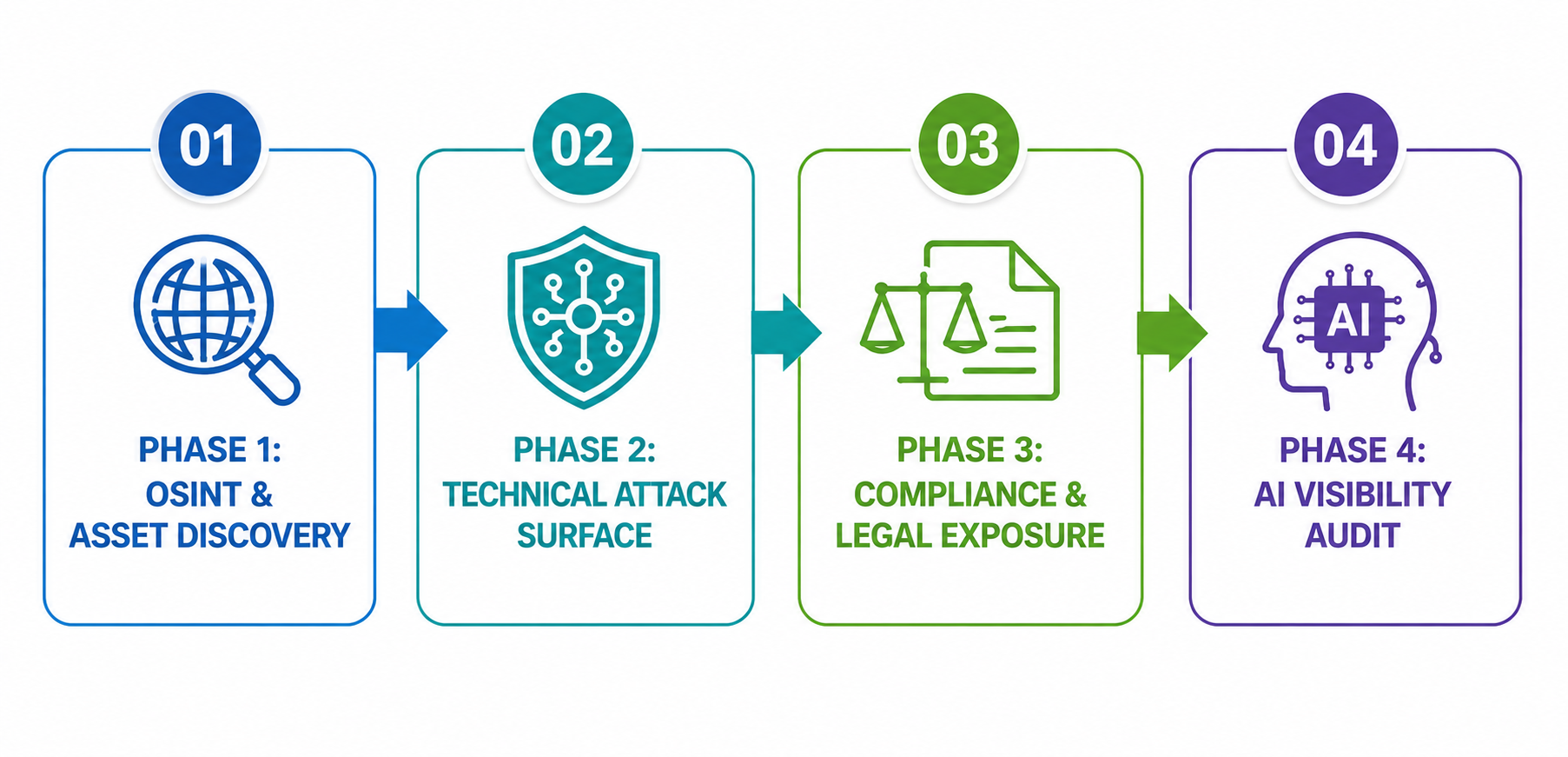
The audit covers four distinct phases: OSINT and asset discovery, technical attack surface, compliance and legal exposure, and AI visibility.
A single audit is a starting point — unmanaged digital footprints are dynamic and require continuous monitoring.
Digital Exposure Audits are the prerequisite for any serious approach to cyber risk assessment, regulatory due diligence, or AI brand control.
The Difference Between a Digital Exposure Audit, a Penetration Test, and Brand Monitoring
We are asked repeatedly: "Isn't this just a pentest?" It isn't. A penetration test exploits vulnerabilities — it requires written authorization and produces exploitation evidence. A Digital Exposure Audit enumerates and assesses without intrusion. Brand monitoring tracks sentiment. These disciplines share a concern with risk, but their methodology, outputs, and commissioning logic are entirely different.
Dimension | Digital Exposure Audit | Penetration Test | Brand Monitoring |
|---|---|---|---|
Primary goal | Map and assess full external exposure | Exploit vulnerabilities to test defenses | Track brand mentions and sentiment |
Methodology | Passive + active enumeration; OSINT; compliance mapping | Active exploitation with authorization | Keyword tracking; media and social listening |
Key outputs | Risk register; remediation roadmap; compliance gap analysis | Exploitation proof; CVE documentation | Mention volume; sentiment trends; share of voice |
Who commissions it | CISO, General Counsel, Board, M&A team | CISO, Red Team lead | Marketing, Communications, PR |
Frequency | Annually + event-triggered | Annually or post-change | Continuous |
Technical access required | None — fully non-intrusive | Yes — authorized scope | None |
Why Our Clients' Digital Footprints Are Always Larger — and More Dangerous — Than They Assume
In every engagement, the first conversation follows the same pattern. The client describes their digital footprint as "our website, our LinkedIn, and a few social accounts." By the time we complete Phase 1, we have catalogued orphaned subdomains, legacy code repositories with committed credentials, data broker aggregations containing home addresses of executives, years of indexed metadata embedded in publicly downloadable documents, and personal data scattered across platforms the organization no longer actively uses. The footprint is never what they imagined. And the risks embedded in it compound: each exposed element enables the next. The anecdote that stays with us came from a 200-person professional services firm — we identified 47 indexed assets the security team had no record of. Three contained live credentials.
Why Your Organization Needs a Digital Exposure Audit Right Now
The most expensive data breach is the one that occurs after you knew the exposure existed but had not yet addressed it. Regulatory frameworks are increasingly treating unmanaged digital exposure as a governance failure, not merely a technical incident. A Digital Exposure Audit, conducted rigorously and documented properly, is how organizations demonstrate that their risk assessment processes are proportionate and their due diligence obligations are met.
The Real Cost of Unmanaged Digital Exposure
Unmanaged digital exposure produces five categories of quantifiable business cost — each distinct, each compounding on the others.
5 Business Risks of Unmanaged Digital Exposure
Breach-related fines and incident costs. IBM's Cost of a Data Breach Report 2024 puts the global average data breach cost at $4.88 million. Personal data exposure is consistently the highest-cost breach category under both GDPR (fines up to 4% of global annual turnover) and CCPA.
Competitive intelligence loss. Exposed technology stacks, organizational hierarchies, vendor relationships, and hiring signals give competitors and adversaries a detailed intelligence picture — without a single intrusion.
Reputational damage. Negative search results, exposed litigation records, and compromised executive digital profiles influence procurement decisions, investor sentiment, and talent acquisition long before any formal incident is declared.
Compliance failure. ISO/IEC 27001 and aligned frameworks treat inadequate information asset inventories as a direct nonconformity. Unaudited digital exposure is, definitionally, an incomplete asset inventory.
AI misrepresentation. Generative AI systems index and perpetuate exposed, inaccurate, or outdated information. A single indexed data breach record, uncorrected, can shape what ChatGPT or Perplexity surfaces about your organization for years.
Phase 1 — How We Map Your Digital Footprint: OSINT and Asset Discovery
Phase 1 of every Digital Exposure Audit begins with the same principle: we think like an adversary conducting pre-attack reconnaissance. Every asset we discover through open-source intelligence is an asset an attacker could discover first. The methodology is disciplined, non-intrusive, and comprehensive — designed to produce a complete inventory before any assessment of risk begins.
What Sophisticated Adversaries Already Know About You: Our Corporate OSINT Findings
The corporate digital footprint is not just your website. It is the aggregate of everything your organization — and everyone connected to it — has ever put online. Adversaries harvest organizational structure, technology stack signals, and key personnel data without any technical intrusion. Personal data aggregated from public sources becomes targeting intelligence. Metadata embedded in publicly downloadable documents has, in multiple engagements, revealed internal file server paths, author credentials, and geographic location data the client had no idea was exposed. Risk is not abstract here: this intelligence is gathered before every sophisticated social engineering attack.
6 Things Adversaries Learn From Your Job Postings Alone
Organizational hierarchy and reporting structure (which roles report to which)
Technology stack — security tools, cloud platforms, development environments
Security tool gaps — what you are hiring to replace or build
Growth priorities — which divisions are expanding and where
Key personnel turnover — departments where institutional knowledge is unstable
Budget signals — contractor rates, tooling spend, infrastructure investment pace
How We Build an Executive Digital Profile: The Human Layer of Organizational Exposure
Executive and senior leadership digital profiles consistently generate the strongest reactions in our audit presentations — because they make the exposure personal. We aggregate publicly available personal data: home addresses accessible through property records, personal email addresses linked to professional accounts, family connections identifiable through social media, and travel patterns reconstructable from public posts and conference appearances. Digital privacy is violated without a single intrusion. The consequence is not hypothetical: in documented attack chains, a compromised personal Gmail account — accessed via credentials found in a third-party data breach — has been the entry point for corporate network compromise. This is the human layer of organizational exposure, and it is almost universally underestimated.
What We Typically Find in Exposed Subdomains, DNS Leaks, and Code Repositories
Three technical categories produce the highest-density findings in Phase 1. First, exposed subdomains and orphaned assets: staging environments left accessible after projects concluded, legacy microsites running unpatched CMS versions, API endpoints with no authentication requirement. Second, DNS and TLS misconfigurations: absent or unenforced DMARC policies enabling domain spoofing, expired certificates creating trust failures, SPF records that permit third-party sender abuse. Third, public code repositories: commits containing hardcoded API keys, database connection strings, and infrastructure configuration files that were never scrubbed. Metadata in these repositories — commit histories, branch names, author emails — extends the digital footprint well beyond the code itself. Each of these is a door left open. The Digital Exposure Audit finds them before someone else walks through.
Phase 2 — Our Technical Attack Surface Management Methodology
Phase 2 moves from passive OSINT to active enumeration of the technical attack surface — every internet-facing system, application, API, and service that could be exploited. This is not penetration testing: we do not cross into exploitation. The methodology is non-intrusive, scope-defined, and analytically driven, with risk assessment providing the bridge between what is found and what it means for the organization. Data breaches do not typically begin with sophisticated zero-days — they begin with forgotten attack surface.
Most Common Shadow IT Categories Found in Enterprise Digital Exposure Audits
Unsanctioned cloud storage (personal Dropbox, Google Drive) containing business-sensitive files
Personal email accounts used for business communications with external parties
Consumer-grade collaboration tools (WhatsApp, personal Slack workspaces) carrying operational data
Employee-built automation tools connecting to corporate systems outside IT visibility
Unauthorized CRM or analytics platforms with access to customer data
The Attack Surface Management methodology at AHOS DIGITAL is directly integrated into our digital architecture and security service — because the surface area we enumerate in Phase 2 is the same surface area that must be designed out in any serious infrastructure architecture.
Unsecured APIs, Outdated CMS Stacks, and Credential Exposure Verification
API endpoint enumeration routinely surfaces publicly accessible routes that development teams believe are internal. CMS version fingerprinting identifies installations running software with publicly known CVEs. Credential exposure verification — cross-referencing executive and employee email addresses against known breach databases — tells us how many organizational accounts are currently associated with compromised passwords in active circulation. This last finding is among the most operationally immediate: it requires no exploitation to produce actionable urgency.
Phase 3 — Our Compliance and Legal Exposure Assessment
Phase 3 is where most security-centric approaches stop short — and where the highest-consequence organizational exposure often lives. Sanctions screening, litigation monitoring, and framework gap analysis belong inside a complete Digital Exposure Audit because digital privacy risk and legal exposure are inseparable from technical exposure. Due diligence at this level is not optional for organizations preparing for M&A, investment rounds, or regulatory examination.
Framework | Relevance to Digital Exposure Audit |
|---|---|
ISO/IEC 27001 | Requires information asset inventory — directly supported by Phase 1 and Phase 2 outputs |
NIST CSF | Identify function maps to asset discovery and risk assessment; Protect function to remediation planning |
GDPR | Mandates data minimization and breach notification readiness — exposed personal data is a direct compliance exposure |
CCPA | Consumer data inventory and deletion rights require complete knowledge of where personal data appears publicly |
Sanctions Screening, Litigation Monitoring, and Digital Footprint Risk Within Compliance Frameworks
Sanctions exposure through digital footprint is an underappreciated vector for organizations operating across jurisdictions. Publicly indexed connections between organizational leadership and sanctioned entities — even where the relationship is historical and dissolved — can surface in counterparty due diligence processes with significant commercial consequence. Litigation records indexed by third-party aggregators, adverse media from jurisdictions outside the organization's primary market, and court filings containing personal data are all components of the compliance and legal exposure profile. ISO/IEC 27001 and aligned frameworks treat information asset control as a governance requirement; our Phase 3 assessment maps digital exposure findings directly to framework control gaps, producing a compliance artifact the organization can present to auditors and regulators as evidence of systematic due diligence.
Phase 4 — Our AI and Generative Engine Visibility Audit
Most organizations have no systematic understanding of how they are represented by ChatGPT, Perplexity, Google AI Overviews, or Gemini. Phase 4 of the Digital Exposure Audit addresses the newest and fastest-evolving layer of digital exposure: the AI representation layer. When a buyer, regulator, or journalist asks an AI system about your organization, the answer they receive is shaped by data your organization may never have sanctioned, reviewed, or even seen. Your digital footprint, once confined to search engine results pages, now shapes AI-generated answers that are often the first and only response a decision-maker receives.
AI Crawler Accessibility and the JavaScript Barrier
The first dimension of AI visibility audit assesses whether your organization's authoritative content is accessible to LLM training and inference crawlers at all. JavaScript-rendered content — the majority of modern web applications — is not processed by most AI crawlers. Organizations investing in content marketing, thought leadership, and GEO-optimized publishing are frequently surprised to discover that none of it is reaching the AI systems their buyers use. robots.txt directives and the emerging llms.txt standard provide explicit controls that most organizations have not yet implemented. Digital privacy risk intersects here: AI crawlers that do access your content index it in ways that may perpetuate outdated, inaccurate, or sensitive information indefinitely.
Factpoint and Citability Audit: What AI Systems Actually Say About You
The citability audit is the most direct component of Phase 4. The AHOS DIGITAL team queries ten AI systems using structured prompts covering organizational description, product and service characterization, leadership profiles, competitive positioning, and risk or controversy associations. The outputs are compared against the organization's authoritative record and assessed for accuracy, recency, and hallucination risk. The Factpoint audit — a structured inventory of factual claims about the organization that should be reinforced across authoritative sources — provides the foundation for the remediation work that follows. This is why the AI Influence & Generative Search Control service at AHOS DIGITAL is built directly on Phase 4 audit methodology: without knowing what AI systems currently say, you cannot know what needs to change.
Generative Engine Optimization (GEO) Gap Assessment
The GEO gap assessment maps the delta between what AI systems currently say about an organization and what they should say, based on the organization's authoritative content and positioning. It identifies the source types — structured data, Wikipedia presence, high-authority third-party citations, press coverage — that most reliably influence LLM outputs, and produces a prioritized content and citation strategy for closing the gap.
Building Our Digital Exposure Audit Report: From Findings to Action
A 200-finding report where every finding carries equal weight is not useful — it is organizational paralysis in document form. Every Digital Exposure Audit the AHOS DIGITAL team delivers is structured around a single principle: prioritized action over comprehensive enumeration. The risk assessment methodology determines what gets addressed in 48 hours, what goes into the 30-day plan, and what constitutes the 90-day roadmap. The timestamped baseline the report establishes also serves as a due diligence artifact: when a regulator or acquirer asks for evidence of your information security posture at a specific past date, this document is what you produce. ISO/IEC 27001-aligned organizations will recognize the output format as directly mappable to Statement of Applicability control evidence.
Risk Tier Prioritization Framework
Risk Tier | Definition | Example Finding Types | Response Timeline | Ownership |
|---|---|---|---|---|
Critical | Immediate exploitation risk or active breach indicators | Live credentials in public repository; unpatched RCE vulnerability on internet-facing system; active data broker listing with executive home address | 24–48 hours | CISO / Executive Sponsor |
High | Significant exposure requiring near-term remediation | Unenforced DMARC policy; orphaned admin interface with default credentials; expired TLS certificates | 14–30 days | Security Team / IT Operations |
Medium | Controlled risk with defined remediation path | Outdated CMS minor version; incomplete asset inventory; inconsistent MFA coverage across non-privileged accounts | 30–90 days | IT Operations / Asset Owners |
Informational | Awareness items; no immediate action required | Shadow IT tool identified but not externally exposed; inconsistent metadata hygiene in internal documents | Next audit cycle | Asset Owners / Team Leads |
6 Measurable KPIs for a Digital Exposure Audit Program
Microsoft Secure Score improvement (percentage point increase from baseline to 90-day reaudit)
MFA coverage on all privileged accounts (target: 100%)
Reduction in externally exposed ports and services (percentage reduction from initial enumeration)
DMARC policy enforcement rate across all owned domains (target: 100% at
rejectorquarantinepolicy)Expired TLS certificate count (target: zero, monitored continuously)
Reduction in executive data broker listing count (measured at 30-day and 90-day intervals)
Why Audit Findings Go Unactioned — and How We Prevent It
5 Reasons Audit Findings Go Unactioned
No named owner assigned to the finding at the time of report delivery
No deadline attached — remediation deferred indefinitely without urgency signal
No executive sponsor to authorize cross-functional remediation effort
Findings written in technical language inaccessible to the people who control budget and priority
No re-audit scheduled to verify closure — the finding remains open with no accountability mechanism
Every audit report from AHOS DIGITAL assigns ownership, timeline, and verification criteria to each finding at point of delivery. This is why the Digital Exposure Audit sits inside our broader digital architecture and security practice — findings do not sit in a report waiting for a separate implementation engagement to begin. The same team that finds the exposure designs the remediation.
From One-Time Audit to Continuous Attack Surface Management
A Digital Exposure Audit conducted once tells you where you stood on the day it was conducted. Like a blood pressure reading, a single measurement tells you nothing about trajectory. Digital footprints are not static: new assets are indexed, employees join and leave, systems are provisioned and forgotten, AI systems update their representations. The organizations we work with at AHOS DIGITAL move from audit-as-event to audit-as-program — with continuous monitoring providing the signal layer and the annual full audit providing the structured reassessment and updated baseline.
Our Continuous Digital Exposure Monitoring Cadence
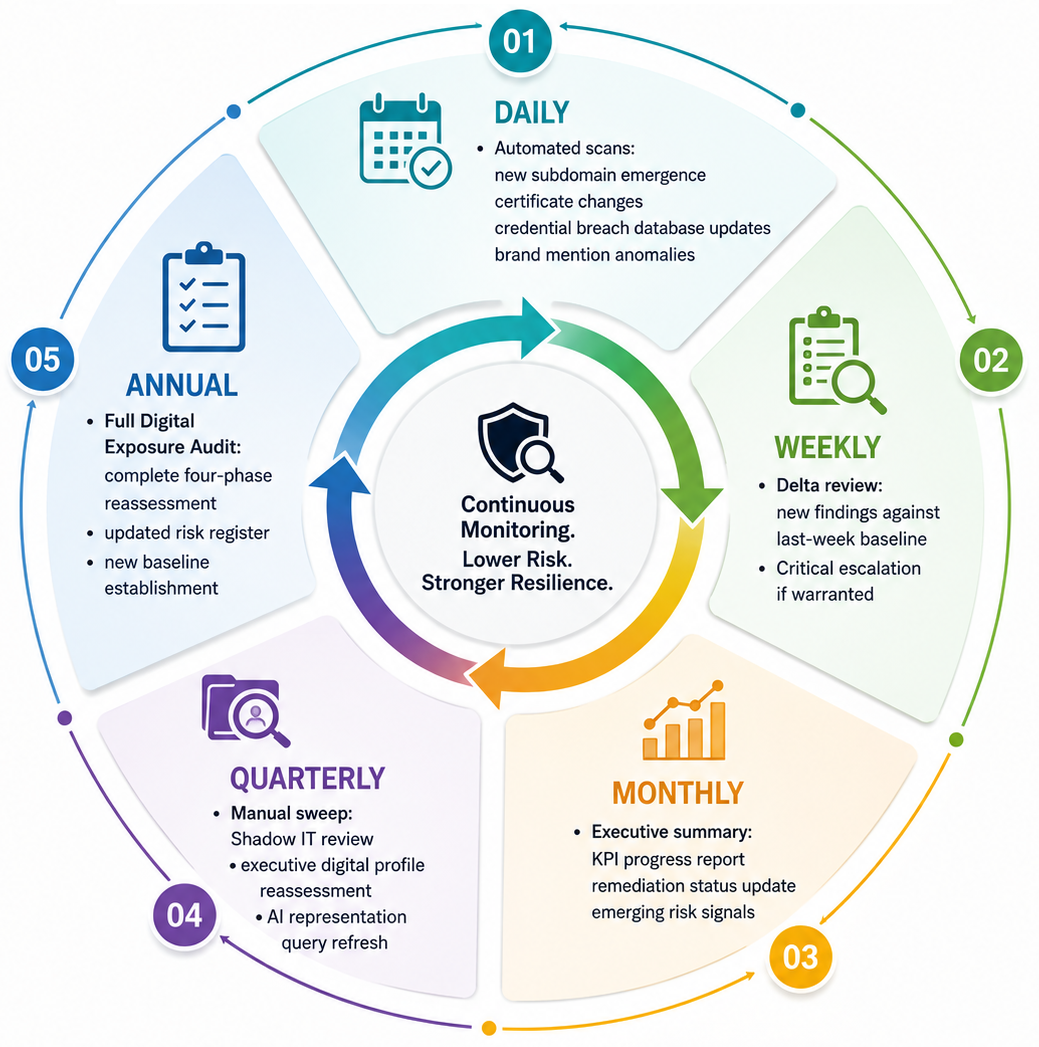
Continuous Digital Exposure Monitoring Cadence
Daily — Automated scans: new subdomain emergence, certificate changes, credential breach database updates, brand mention anomalies
Weekly — Delta review: new findings against last-week baseline; critical escalation if warranted
Monthly — Executive summary: KPI progress report, remediation status update, emerging risk signals
Quarterly — Manual sweep: Shadow IT review, executive digital profile reassessment, AI representation query refresh
Annual — Full Digital Exposure Audit: complete four-phase reassessment, updated risk register, new baseline establishment
Our Conclusion — Digital Exposure Is a Business Risk, Not Just an IT Problem
If your organization has never experienced a confirmed breach, the honest conclusion may be that your exposure is larger than you know — not smaller than you fear. The organizations best positioned for the AI-mediated discovery environment ahead are those that treat their digital footprint as a managed business asset, not a byproduct of operations. Digital privacy, due diligence, and competitive positioning all depend on the same foundational visibility that a rigorous Digital Exposure Audit provides. The organizations building this practice today will be substantially better positioned as generative AI becomes the primary discovery mechanism for buyers, regulators, and journalists. Begin with Phase 1.
Frequently Asked Questions
What is a Digital Exposure Audit and how is it different from a penetration test?
A Digital Exposure Audit maps everything your organization exposes publicly — across domains, personnel, infrastructure, and AI-indexed representations — without any system intrusion. A penetration test actively exploits vulnerabilities within an authorized scope. They address different questions: exposure audits answer "what can be seen?" while pentests answer "what can be broken into?" Both are valuable; neither substitutes for the other.
What information is typically found during a digital exposure audit?
Typical findings include orphaned subdomains, exposed API endpoints, hardcoded credentials in public code repositories, executive personal data indexed by data brokers, DNS misconfigurations enabling domain spoofing, expired TLS certificates, Shadow IT tools with corporate data access, and inaccurate AI-generated descriptions of the organization. Most AHOS DIGITAL engagements surface 40–80 distinct risk points the organization had no prior record of.
How often should a digital exposure audit be conducted?
A full four-phase Digital Exposure Audit should be conducted annually, and additionally following material organizational events: acquisitions, leadership changes, major infrastructure changes, or any confirmed security incident. Between annual audits, continuous automated monitoring covers the dynamic elements of the digital footprint — new assets, new breach data, new AI representations.
What are the common risks associated with a large digital footprint?
The primary risks are data breach enablement through exposed credentials and unmanaged attack surface, competitive intelligence leakage through publicly visible organizational and technology stack signals, regulatory non-compliance under GDPR and ISO/IEC 27001 which require complete information asset inventories, reputational damage from indexed negative or inaccurate content, and AI misrepresentation — inaccurate generative AI outputs that persist and influence buyer and investor perception long after the underlying facts have changed.