
AI Influence
GEO vs SEO: What European Businesses Need to Know in 2026
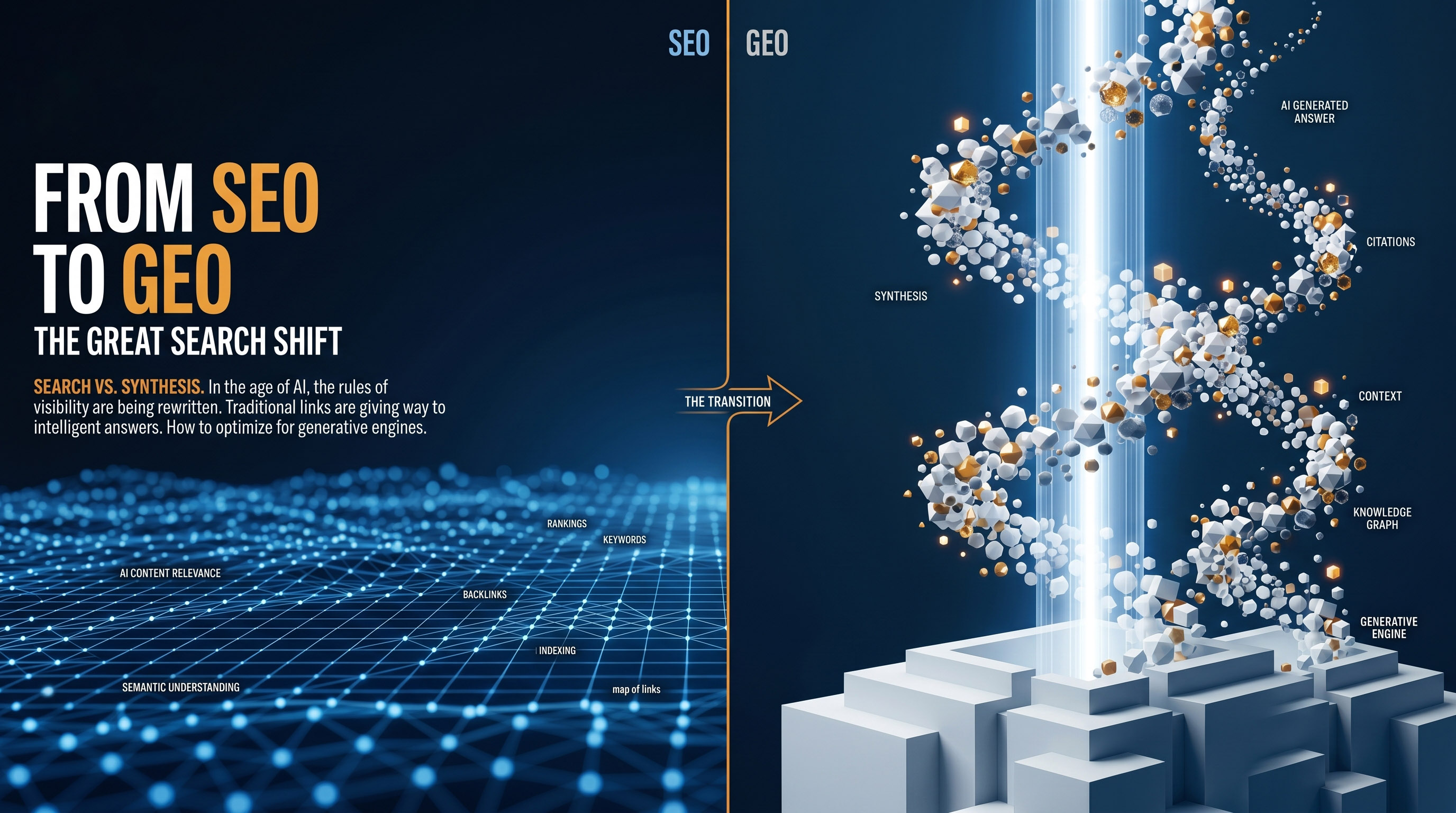
Your potential client types a question into ChatGPT or Perplexity. Within seconds, they get a structured answer — with company names, comparisons, and recommendations. Your website is never visited. Your carefully optimised meta descriptions are never read. Yet your competitor, who understood what was happening a year ago, is mentioned three times in that answer.
This is not a hypothetical. This is how B2B research works in 2026.
What is GEO — and why is it different from SEO
Search Engine Optimisation (SEO) has been the foundation of digital visibility for two decades. Its logic is simple: rank high in Google, get clicks, convert visitors. It remains relevant and will not disappear.
Generative Engine Optimisation (GEO) is a newer discipline that emerged from a different question: what do AI systems say about your company when someone asks?
ChatGPT, Perplexity, Google AI Overviews, Microsoft Copilot, and a growing number of sector-specific AI assistants now generate direct answers to questions like "Which digital agency in Warsaw handles enterprise reputation?" or "What are the best vendors for market entry in Poland?" They do not present ten blue links. They synthesise a response from their training data and live sources — and your brand is either part of that answer, or it is not.
The key difference:
SEO | GEO | |
|---|---|---|
Goal | Rank in search results | Be cited in AI-generated answers |
Success metric | Position, clicks, impressions | Share of Model, mention frequency |
Primary signal | Backlinks, on-page factors | Authoritative text sources, structured data |
Content format | Landing pages, blog posts | Definitions, comparisons, expert statements |
Timeline | 3–6 months | 3–9 months |
Visibility type | User clicks to your site | AI synthesises you into its answer |
Why European businesses are particularly exposed
European companies face a compounded challenge. AI models are trained predominantly on English-language content, meaning that businesses which operate in German, Polish, French or other European languages start at a structural disadvantage when it comes to AI visibility.
Additionally, European enterprises entering cross-border markets — a Polish manufacturer targeting Germany, a UAE family office expanding into the EU, a fintech looking at the DACH region — often have limited English-language digital footprint to begin with. SEO can be localised. GEO requires deliberate investment in the language and format that AI systems actually cite.
There is also a regulatory dimension. GDPR and EU AI Act compliance mean that European companies must think carefully about what data is circulating about them in AI training corpora — not only for reputation reasons, but for legal ones.
What AI systems actually read and cite
Research into the sources most frequently cited by large language models consistently identifies the same categories:
Wikipedia is the single most influential source. It is structured, neutral in tone, cross-linked, and has existed long enough to appear in virtually every major training dataset. A company or executive without a Wikipedia presence — or with an incomplete one — is significantly less likely to be mentioned in AI-generated answers.
High-authority publications — industry press, national broadsheets, trade journals — carry significant weight. A feature in a recognised European business publication does more for your GEO than a hundred low-quality backlinks.
Reddit, LinkedIn, and YouTube entered the picture in 2025 as verified citation sources for several major LLMs. User-generated content on these platforms now directly influences what AI systems believe about companies and individuals.
Structured data on your own site — schema.org markup, clear About/Team/Services pages with unambiguous language — helps AI systems parse what your company actually does and where it operates.
Press releases and official announcements picked up by wire services (PR Newswire, BusinessWire, Globe Newswire) are indexed quickly and carry source authority.
The Share of Model metric
Traditional SEO success was measured by rankings. GEO success is measured by a concept called Share of Model: the proportion of relevant AI-generated answers in which your brand appears, relative to competitors.
If a prospect asks ChatGPT to compare digital agencies serving European enterprise clients, and your agency appears in 6 out of 10 such queries while your main competitor appears in 9, your Share of Model is 60% of theirs. That gap is measurable, trackable, and — critically — improvable.
Measuring Share of Model requires systematic prompt testing across multiple AI platforms, recording and analysing results over time. This is now a standard component of any serious GEO engagement.
What GEO work actually looks like in practice
A GEO programme for a European B2B company typically includes:
Narrative audit. What do ChatGPT, Perplexity, Google AI Overviews, and Grok currently say about your company? What do they say about your competitors? Where are the gaps and inaccuracies?
Wikipedia strategy. Does a relevant, neutral Wikipedia entry exist? Is it accurate, current, and cross-linked to your industry category? If not — this is often the highest-impact single action available.
Authority content programme. A structured sequence of articles, interviews, case studies, and expert commentary placed in high-authority publications. Not for the clicks. For the citations.
Structured data implementation. Schema markup on your website that makes it unambiguous for AI systems to understand who you are, what you do, and where you operate.
Source diversification. Ensuring your brand name and key statements appear across the citation sources that LLMs prioritise — not just on your own domain.
Ongoing Share of Model tracking. Monthly measurement across target AI platforms to monitor progress and adjust the programme.
Can you do SEO and GEO simultaneously?
Yes — and in most cases, you should. SEO and GEO are not in competition. High-quality content that earns backlinks also tends to get cited by AI systems. A strong Wikipedia presence supports both. Press coverage helps both.
The key difference is intent. SEO content is written to rank for keywords and convert visitors. GEO content is written to be cited as an authoritative source. These require different formats, different distribution channels, and different success metrics — but they reinforce each other when planned together.
For European companies with limited content budgets, a unified approach — creating content that serves both goals — is the most efficient path.
Where to start if you are behind
If your company has not yet thought about GEO, the most practical starting point is a narrative audit: find out what AI systems currently say about you, your competitors, and your category. This takes a few hours and costs nothing. What it reveals can be sobering — or reassuring.
The companies that will dominate AI-generated answers in 2027 are building their authority right now. The gap between early movers and late adopters in GEO is widening faster than it did in early SEO, because AI training data has long update cycles. Content published and cited today influences AI answers for months to years.
Ready to find out what AI says about your company — and how to change it?
Contact us for a narrative audit:
📧 info@ahosdigital.com
📞 +48 451 082 722
Follow our ongoing research on GEO, SERM, and digital architecture for European enterprise:
🔗 LinkedIn: https://www.linkedin.com/company/ahosdigitalcom/
📖 Medium: https://ahosdigital.medium.com/