
Reputation
Digital reputation due diligence: what acquirers check before signing
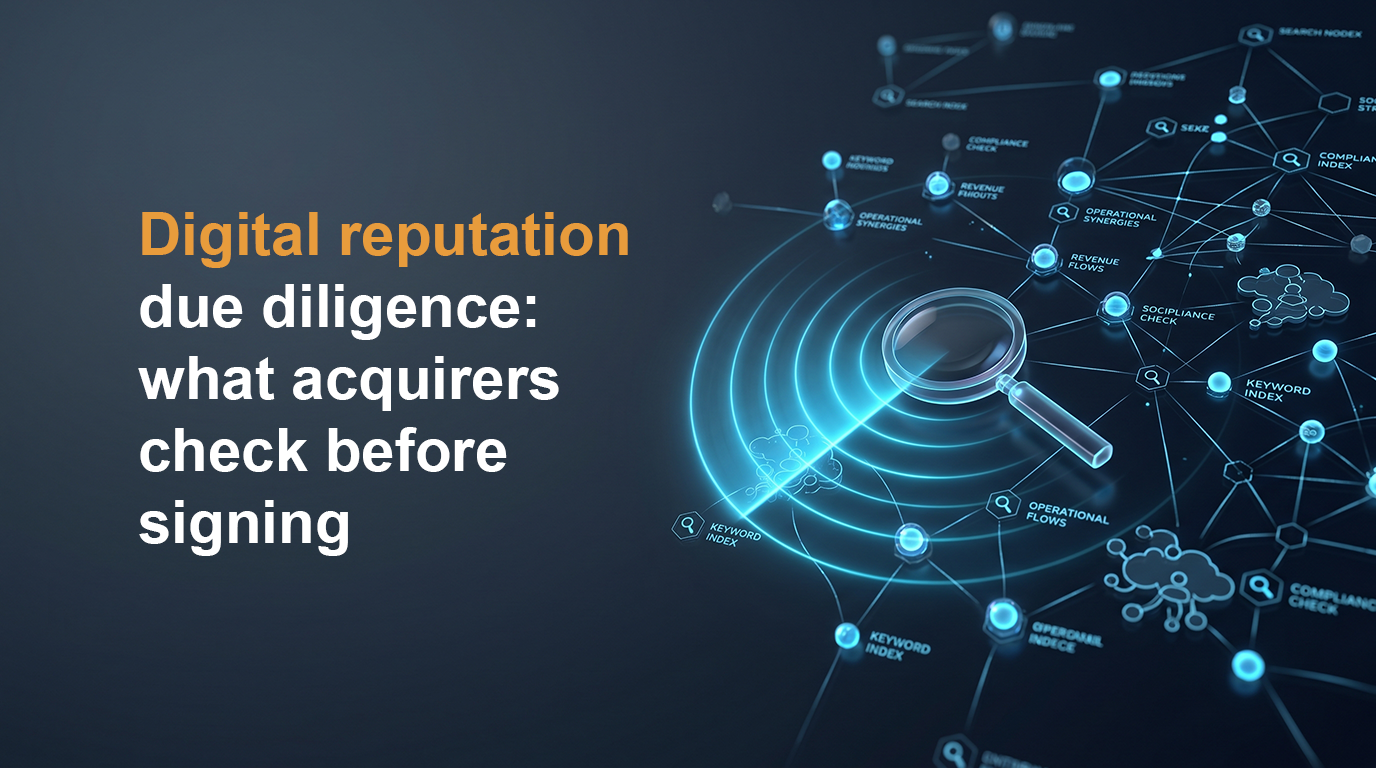
The letter of intent has been signed. The data room is open. Legal, financial, and operational due diligence is underway.
What the target company does not know is that a parallel process has already begun — one that does not require access to the data room, cannot be controlled by the target's advisors, and may have already produced conclusions that will affect the deal.
It is called digital reputation due diligence. And in 2026, it is standard practice among private equity firms, strategic acquirers, and institutional investors operating in European markets.
What digital reputation due diligence actually covers
Traditional due diligence has a defined scope: financial statements, legal structure, operational assets, regulatory compliance, contractual obligations. Digital reputation due diligence runs a parallel track through the open web, AI systems, and social media — assembling a picture of how the target company, its leadership, and its key products are perceived and represented in the digital environment.
The scope typically includes seven layers.
Search results and search narratives. What appears when you search the company name, its executives, its products, and its key relationships? What appears on pages 2 and 3, where reputation risks are often buried? Are there patterns of negative coverage, unresolved controversies, or damaging associations that have accumulated over time?
AI-generated summaries. What do ChatGPT, Perplexity, Google AI Overviews, and Microsoft Copilot say about the company when asked directly? AI systems now synthesise assessments from across the web, and those assessments are increasingly the first information a counterparty receives about a target. Inaccuracies and reputational negatives embedded in AI answers are particularly difficult to correct quickly.
Review platforms and ratings. Glassdoor, Trustpilot, Google Reviews, sector-specific platforms — these carry information about employee sentiment, customer experience, and operational quality that does not appear in financial statements. A company with strong EBITDA and a 2.1 Glassdoor rating is telling an acquirer two different stories.
Social media and forum presence. What is said about the company on LinkedIn, Reddit, Twitter/X, and sector-specific forums? What do employees, former employees, customers, and competitors say? Forum discussions in particular have become primary citation sources for AI systems, making them more consequential than they once were.
Executive and key person reputation. M&A transactions are often as much about acquiring leadership as acquiring assets. The digital reputation of the CEO, CFO, and other key individuals — historical controversies, prior company associations, patterns of public statement — is routinely assessed as part of this process.
Wikipedia and reference entries. The accuracy, completeness, and neutrality of Wikipedia entries about the company and its leadership is reviewed. Gaps, inaccuracies, or the absence of an entry where one would be expected are noted and interpreted.
Regulatory and legal digital trail. Court records that have made it into the press, regulatory enforcement actions, data breach disclosures, environmental incidents — the digital record of legal and regulatory history is searched systematically.
Why this layer of due diligence has become standard
Several converging factors have made digital reputation due diligence a standard component of enterprise M&A in European markets.
The first is the rise of AI-assisted research. The speed and accessibility of AI-generated company summaries means that counterparties — co-investors, lenders, regulators, integration partners — are forming initial views of a target from AI answers before any formal introduction. What those answers say matters commercially.
The second is the documented correlation between digital reputation and post-acquisition outcomes. Acquirers who have completed integrations with reputation-damaged targets consistently report higher-than-expected costs in customer retention, employee retention, and commercial partnership renewals. The digital reputation of a target is now understood as a component of enterprise value, not merely a communications issue.
The third is the regulatory environment. GDPR, the EU AI Act, and sector-specific compliance frameworks in financial services and healthcare have created legal dimensions to a company's digital footprint — what data is publicly associated with it, what AI systems are saying about it, and whether those representations create liability.
The fourth is deal velocity. In competitive auction processes, preliminary digital reputation assessments are now conducted before formal engagement — often as part of the initial screening that determines whether a target makes it to the shortlist at all.
What sophisticated acquirers look for — and what raises flags
Experience across European M&A transactions identifies a consistent set of signals that acquirers assess during digital reputation due diligence.
Coherence between the narrative and the record. Does the company's own description of itself — its history, its market position, its leadership credentials — match what appears in independent sources? Inconsistencies between self-representation and the external record raise questions about reliability and transparency.
Concentration of negative signals. A single negative press mention from three years ago is contextualised differently from a pattern of recurring criticism across multiple platforms and sources. Acquirers assess whether negative digital signals are isolated incidents or systemic patterns.
The gap between operational quality and digital perception. A company whose operational performance is strong but whose digital representation is poor has a correctable problem. A company whose digital representation is strong but whose operational reality is weak has a different and more serious problem. The relationship between these two reads is evaluated carefully.
AI answer accuracy and completeness. When AI systems are queried about the target, do the answers accurately reflect the company's current position, products, and leadership? AI systems that produce systematically inaccurate or outdated information about a target are both a reputation risk and an indicator of weak AI-visibility management — which sophisticated acquirers now consider a governance gap.
The digital reputation of key executives. Prior associations with failed companies, litigation history, patterns of controversial public statement, and — increasingly — what AI systems say about individuals directly when asked, are assessed in detail. Executive digital reputation has derailed transactions at late stage.
Absence of expected signals. For a company of a given size, age, and market position, a certain level of digital presence is expected. A company that is significantly under-represented in search results, AI answers, industry databases, and reference sources — relative to its claimed market position — raises questions that require explanation.
What targets should do before the process begins
The best time to conduct digital reputation due diligence on your own company is before an acquirer does it for you.
This means running the same seven-layer assessment on yourself: searching your own name and your executives' names systematically, querying AI systems directly, reviewing what review platforms and forums contain, assessing the accuracy of your Wikipedia entry, and mapping the gap between how you present yourself and how independent sources represent you.
What this exercise typically reveals falls into three categories.
Correctable factual inaccuracies: outdated information in Wikipedia entries, incorrect details in industry databases, AI-generated summaries that contain errors. These can be addressed through structured data updates, Wikipedia corrections, and targeted content that provides accurate reference material to AI systems.
Reputational negatives with active remediation potential: negative press coverage that can be contextualised, review platform ratings that can be improved through operational changes, social media narratives that can be addressed through transparent engagement.
Structural digital gaps: categories of expected presence that simply do not exist — no Wikipedia entry, no press archive, no schema markup, no structured industry record. These take longer to build but are among the most actionable findings, because their remediation is methodical and predictable.
The timeline matters. Digital reputation cannot be meaningfully remediated in the weeks between signing an LOI and completing due diligence. The work required — Wikipedia entries, authority press placements, structured data implementation, AI citation building — operates on a 3–9 month horizon. Companies that wait until a transaction is in progress to address their digital reputation typically find that the window has already closed.
The AHOS DIGITAL approach to pre-transaction digital reputation
We work with European companies and their advisors at two points in the transaction lifecycle.
The first is pre-transaction preparation: conducting a comprehensive digital reputation audit, identifying the gaps and risks that an acquirer's due diligence team will find, and building a remediation programme that addresses them before the process begins. This work typically runs 3–6 months ahead of an anticipated transaction.
The second is during-transaction support: providing real-time monitoring of what AI systems and digital sources are saying about the target during the due diligence process, responding to inaccuracies as they surface, and advising on how to present the digital reputation picture to acquirers in a way that is transparent and defensible.
Both engagements begin with the same step: a comprehensive digital reputation audit that maps exactly where you stand across all seven layers — before anyone else does.
Planning a transaction or preparing for one?
Contact us for a digital reputation audit:
📧 info@ahosdigital.com
📞 +48 451 082 722
Follow our ongoing research on digital reputation, GEO, and digital architecture for European enterprise:
🔗 LinkedIn: https://www.linkedin.com/company/ahosdigitalcom/
📖 Medium: https://ahosdigital.medium.com/